
How to frame a painting?
Choosing frames for graphics or oil paintings is not an easy task. First, you need to select a frame style that matches the painting's style, and then the space where it will be hung. The frame acts as a mediator between the interior and the painting. Properly chosen frames can help the painting become a true home decoration, but if chosen incorrectly, they can do just the opposite and "ruin" the home space. If selecting a frame is difficult, we recommend consulting with professionals and considering these five radical framing methods.
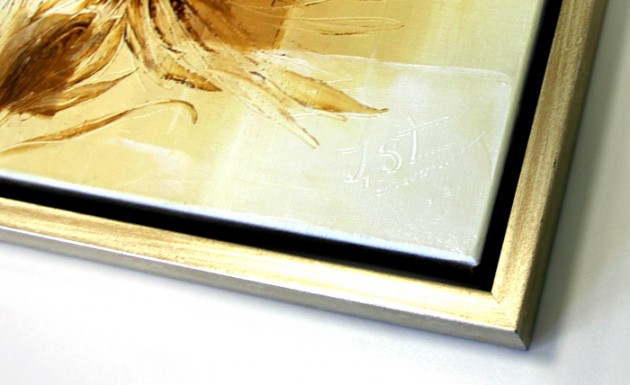
1. Frames with a gap
Frames with a gap are a popular framing method abroad, where the painting is attached to the front of the frame, leaving a gap between its edges – this can range from a few millimeters to a few centimeters. Visualizing it, it seems that the painting "floats" in the frame – hence, in English, these special frames are called "floating frames." This is a great choice if your interior is dominated by a modern style and you want to highlight the painting.
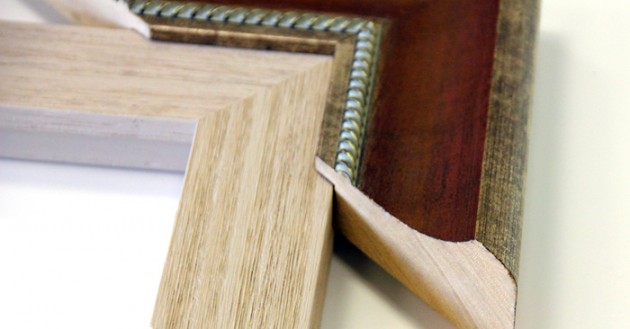
2. Frame... the frame!
If you want to expand a wooden frame, the painting can be framed... twice! This can be done with not all moldings. The first one must have a flat edge so that the second frame can beautifully cover it. Visualizing it, this method expands the frame around the painting, increases it, and allows you to highlight and emphasize more colors. Note that the second molding should also be deeper to beautifully cover the edges.
3. Size – important!
Mat boards are designed to protect the painting from contact with glass, but at the same time, they also serve an aesthetic function. A mat board provides an additional opportunity to highlight the painting's color and emphasize its most beautiful parts. A mat can simply have a regular cut for the painting (its edges are usually cut at a 45-degree angle), or it can be done differently – using multiple mats to create a unique frame.
If you want to be even more original, you can order wide mats – if the sides exceed the cut dimensions several times, the overall image can look very creative.
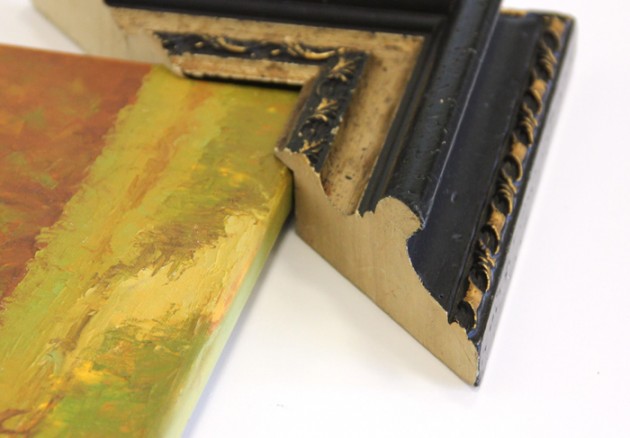
The same can be applied to frames – if you choose an especially wide frame in which to place a small painting image, you can visually enlarge the work itself and give it additional value.
4. Painting mosaic
Imagine you have several small graphic works. You can frame them all separately, or... all in one large frame! Most framing workshops can cut several openings in one mat – thus, you can create a beautiful mosaic and hang it on the wall.
5. Cut
This framing method is the most radical. Remember that inherited painting your uncle painted back in school? You don't like it, so it sits in the closet collecting dust. And the youngest, while looking for skates, even cut a hole in it. Start cutting.
Cut only a small detail – a tree or a sunset. Choose a suitable, massive frame, and you will have a small masterpiece. Attention! Cutting is a responsible task, so it's best to think carefully before doing it, or consult with professionals at framing workshops – they will help you cut and, if necessary, secure the painting on the sub-frame.